RF accelerating cavity: a DIY science project
2026-07-14
Channel: EuPRAXIA (125 subscribers)
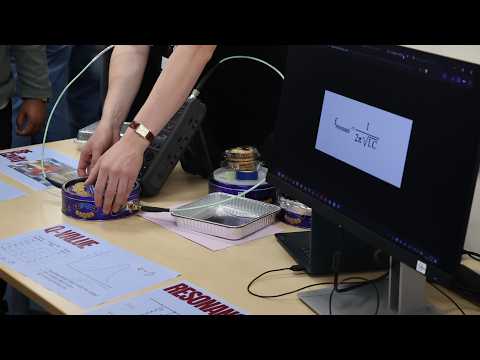
Particle accelerators sound like the exclusive domain of billion-dollar facilities, but the fundamental physics of an RF accelerating cavity can be demonstrated on a tabletop with surprisingly simple hardware. This outreach video from EuPRAXIA — a European plasma-accelerator research collaboration — walks through how metal cavities store electromagnetic energy at resonance, and why that stored energy is what actually kicks charged particles up to relativistic speeds.
What makes this worth your time is the concrete, visual treatment of resonance and Q factor. Rather than starting from Maxwell's equations, the presenters build intuition: a cavity is essentially a 3D LC circuit where the geometry sets the resonant frequency, and the surface conductivity sets how long energy sloshes around before being lost as heat. Once you see it demonstrated with real metal cans and a signal source, the leap to understanding why superconducting cavities matter — or why cavity shape optimization is a whole subfield — becomes obvious.
The DIY angle also grounds a topic that's usually presented with intimidating CAD renderings and cryogenic plumbing diagrams. If you've ever built a cavity filter, tuned a helical resonator, or wondered how a magnetron actually works, the same physics is at play here. It's a good bridge between amateur RF/microwave work and big-science instrumentation.
