Practical #2: STM32 Crystal & Load Capacitors in KiCad | HSE Clock Circuit Design
2026-06-15
Channel: Code To Win (1840 subscribers)
Most "design an STM32 board" tutorials hand-wave past the crystal oscillator circuit — they drop in a 8 MHz crystal, two mystery capacitors, and move on. This video does the opposite: it zooms in on the HSE (High-Speed External) clock circuit and explains why those load capacitors matter and how to actually calculate their values.
The load capacitor calculation isn't arbitrary. It depends on the crystal's specified load capacitance (CL) and the parasitic / stray capacitance of your PCB traces and pads, using the classic formula CL = (C1·C2)/(C1+C2) + Cstray. Get it wrong and your STM32 either won't start oscillating, will start unreliably across temperature, or will run slightly off-frequency — which is a nightmare for USB or precise timing peripherals.
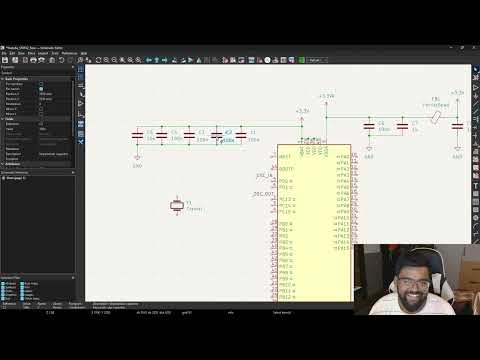
Because this is part of an ongoing "build an STM32 dev board from scratch" series, the crystal circuit gets shown in the context of a real schematic in KiCad, with footprint choices and placement considerations rather than just theory. For anyone who has copy-pasted reference designs without understanding them, this is the kind of focused 10-minute deep-dive that fills a specific gap.
