Daily Digest — 2026-07-08
24 newsletters today.
In this digest
- Abandoned Futures — The Bell Model 65 ATV (Air Test Vehicle): The 1953 Jet-Lift VTOL That Hovered on Two Rotating Turbojets Before the Harrier Was a Napkin Sketch
- ArXiv Paper Digest — Agents That Teach: Towards Designing Incidental Learning Back into AI-Assisted Software Development
- Daily Automotive Engines — Exhaust Header V-Band Clamp Flange Sealing Surface Hardness: Why Soft Flanges Deform Under Load
- Daily Debugging Puzzle — Python's Vacuous Truth Trap: The Permission Check That Approves Everything
- Daily Digital Circuits — Latch-Based Design and Two-Phase Non-Overlapping Clocks
- Daily Electrical Circuits — Pi and T Filters: EMI Suppression Networks for Power and Signal Lines
- Daily Engineering Lesson — Splines: Transmitting High Torque Through Multiple Simultaneous Teeth
- Forgotten Patent — Wilson Greatbatch's "Medical Cardiac Pacemaker": The 1962 Patent Filed by an Engineer Who Grabbed the Wrong Resistor — and Invented the Implantable Pacemaker
- Daily GitHub Zero Stars — dcvibecodes/portfolio-tracker-app
- Daily Hardware Architecture — The Floating-Point Fused Multiply-Add Rounding Advantage: Why FMA Isn't Just Faster, It's More Accurate
- Hacker News Deep Cuts — Ex-NASA boss points out small flaw in Moon landing plan: No lander
- HN Jobs Teardown — Synthetic Minds: What Their Hiring Reveals
- Daily Low-Level Programming — The perf_event_open Syscall and the ring_buffer_pages Argument: How Profilers Read PMU Counters Without a Syscall Per Sample
- RFC Deep Dive — RFC 5952: A Recommendation for IPv6 Address Text Representation
- Stack Overflow Unanswered — Why does my dynamic XCFramework work without its dependency, but the static XCFramework gives undefined symbols?
- Daily Software Engineering — The Space-Saving Algorithm: Finding Frequent Items in a Single Pass
- Tool Nobody Knows — chattr and lsattr: The Filesystem Flags Even root Has to Think Twice About
- What If Engineering — What If We Built a Skyscraper-Sized Fresnel Lens That Focused Sunlight to Smelt Steel Without Coal?
- Wikipedia Rabbit Hole — Transition-edge sensor
- Daily YT Documentary — One Small Mistake That Changed Human History Foreverhuman historyhistory documentary youtube
- Daily YT Electronics — I Can't Believe How Good This $9 DIY Kit Is
- Daily YT Engineering — Does Blender Actually Obey the Laws of Fluid Dynamics? | CGI Fluid Simulation Vs Newtonian Physics
- Daily YT Maker — How to Use Procreate Doodles in Cricut Design Space ✨ | Easy Tutorial #diy #craft #cricut #procreate
- Daily YT Welding — Precision Machining a Massive Rotary Tiller Gear | Industrial Lathe Restoration"
Abandoned Futures
The Bell Model 65 ATV (Air Test Vehicle): The 1953 Jet-Lift VTOL That Hovered on Two Rotating Turbojets Before the Harrier Was a Napkin Sketch
2026-07-08
In November 1953, a spindly contraption made of welded steel tube, a Bell Model 47 helicopter cockpit bubble, and two Fairchild J44 turbojets mounted on trunnions lifted off the ground at Niagara Falls Airport. It hovered. It transitioned into forward flight. It landed. And almost no one remembers it existed.
The Bell Model 65 Air Test Vehicle was the first American aircraft to achieve vectored-thrust jet VTOL flight — six years before the Hawker P.1127 (Harrier prototype) flew, and eight years before the Short SC.1 demonstrated full transition. Its designer, David Forman, working under Bell's chief of preliminary design Kenneth Wernicke, built it on a shoestring: no government contract, no formal program, just Bell's internal R&D budget and a determination to prove that swiveling the engines themselves — rather than deflecting exhaust through nozzles — could work.
The specs are almost comical in their simplicity:
- Two Fairchild J44-R-3 turbojets, each producing about
1,000 lbfof thrust, mounted on gimbals that rotated from vertical (lift) to horizontal (cruise) - Empty weight: roughly 2,000 lb — the airframe was mostly exposed tubing
- Attitude control in hover via a bleed-air reaction control system — pressurized air ducted to nozzles at the nose, tail, and wingtips. This is exactly the system the Harrier would use two decades later.
- First tethered hover: November 16, 1953. First free hover: January 1954. Transition to wingborne flight: achieved in a series of test hops through 1955.
So why don't you know about it? Three reasons:
1. Thrust-to-weight was brutal. Two J44s at 1,000 lbf each gave 2,000 lbf total thrust against a 2,000 lb airframe — a T/W ratio of barely 1.0 with no payload, no fuel margin, and no pilot. Every hover was a knife-edge exercise. The J44 was a target-drone engine; nothing more powerful was small enough to fit.
2. Bell had a bigger horse in the race. The company was already deep into the XV-3 tiltrotor program (which led directly to the XV-15 and V-22). Management saw jet VTOL as a distraction from Bell's real bet: rotors. Forman's team got cannibalized.
3. The Air Force wasn't buying. In 1954, USAF was fixated on Mach 2 interceptors and strategic bombers. A subsonic testbed proving a hover concept had no procurement pathway. The Model 65 was donated to the Smithsonian in 1955 and sat in storage for 50 years.
Why revisit it now? The Model 65's core insight — rotating the entire engine rather than the exhaust — is exactly what's making the current generation of eVTOL aircraft work. Joby, Archer, and Beta all tilt their propulsors bodily. The reason it failed in 1953 was thrust-to-weight; today's high-bypass turbofans hit T/W of 8:1, and electric ducted fans approach 15:1 at the disk. A modern Model 65 with two Williams FJ44-class engines (3,600 lbf each, 450 lb dry) would have a hover T/W of 3.6 — luxurious. Add fly-by-wire (Forman's pilot was fighting mechanical linkages) and the aircraft becomes trivially controllable.
The Harrier's Pegasus engine cost $400 million to develop across 15 years. Forman built a working proof of the same idea for the cost of two drone engines and a welded frame. The concept was never wrong — it just needed engines that hadn't been invented yet.
ArXiv Paper Digest
Agents That Teach: Towards Designing Incidental Learning Back into AI-Assisted Software Development
2026-07-08
Authors: Rohit Mehra, Samdyuti Suri, Prithviraj K Tagadinamani, Kapil Singi
ArXiv: 2607.06101v1
PDF: Download PDF
Here's a question that's been quietly nagging at the software industry: if AI agents are writing more and more of our code, how do junior developers actually become senior developers? This paper takes that worry seriously and proposes a concrete design direction.
The authors start with an observation most developers will recognize. A big chunk of what makes someone good at software isn't taught in courses — it's picked up sideways. You wrestle with a weird bug for three hours and end up understanding how DNS actually works. You read a colleague's PR and learn a pattern you'd never seen. You try the naive approach, it fails, and now you understand why the framework does the thing it does. Researchers call this incidental learning: knowledge you weren't trying to acquire, gained through the friction of doing real work.
AI coding agents remove that friction. That's the point of them — you describe what you want, they produce code, you move on. Great for productivity in the short term. But the paper argues that when developers delegate substantial coding tasks to autonomous agents, the muscles they used to build through struggle simply don't get exercised. Skills atrophy silently. The productivity gains are real, but so is the long-term cost: a generation of developers who ship a lot but understand less.
The paper's contribution is a design agenda for what the authors call agents that teach. Rather than treating "get the task done" as the sole objective, teaching agents would deliberately preserve moments of learning. Concretely, they sketch ideas like:
- Explaining the why behind a chosen approach, not just handing over the diff
- Occasionally pausing to ask the developer to make the judgment call themselves
- Surfacing alternatives that were considered and rejected, so the developer sees the tradeoff space
- Adapting how much scaffolding to provide based on the developer's apparent skill level
The key insight is a reframing: incidental learning isn't a nice-to-have side effect of manual coding — it's infrastructure for the software profession. If we build agents that optimize purely for task completion, we're quietly dismantling that infrastructure. The paper argues we should treat "did the developer learn something?" as a first-class design goal alongside "did the task ship?"
It's more of a research agenda than a finished system, but it names something important that the current wave of coding-agent papers has mostly ignored.
Daily Automotive Engines
Exhaust Header V-Band Clamp Flange Sealing Surface Hardness: Why Soft Flanges Deform Under Load
2026-07-08
You've spent the last dozen lessons on V-band flange geometry — angle, runout, finish, concentricity. But there's one property that quietly determines whether all that precision survives the first heat cycle: surface hardness. A perfectly machined flange with soft parent material will cold-flow under clamp load, and everything you paid for at the mill disappears in fifteen minutes of driving.
V-band clamps generate enormous localized contact pressure. The clamp's 20-degree wedge geometry multiplies bolt tension into radial squeeze — a T-bolt torqued to 100 in-lb can generate 3,000–5,000 psi of contact stress at the sealing bead. If the flange face yields at that stress, the sealing surface plastically deforms, opens up microscopic gaps, and starts leaking exhaust.
Hardness by material:
- 304 stainless (annealed): ~150–180 HV (Vickers). Cheap, weldable, but soft. Fine for low-boost N/A applications.
- 321 stainless: ~180–200 HV. Titanium-stabilized, better creep resistance at temperature — the standard for turbo hot-side flanges.
- Inconel 625: ~220–260 HV at room temp, and critically, it retains hardness above 1400°F where 304 falls off a cliff.
- 17-4 PH stainless: ~380–400 HV precipitation-hardened. Overkill for headers, but shows up on race turbo housings.
The hot-hardness problem: Room-temperature hardness lies. At 1500°F exhaust temps, 304 stainless drops to about 60% of its cold hardness. A flange that measured 170 HV on the bench is now behaving like 100 HV under load. This is why cheap eBay stainless V-bands leak after a few heat cycles — the material creeps, the sealing bead flattens, and the clamp can't take up the slack.
Real-world example: Precision Turbo's T4 divided V-band housings use 347 stainless (321's cousin) specifically because it holds 180+ HV at 1600°F. Compare that to a generic import flange in 304 that's effectively 90 HV at temperature — the Precision unit stays sealed at 40 psi of boost; the import warps and weeps within a season.
Rule of thumb: Your flange material should have hot hardness (at operating temp) of at least 150 HV to survive V-band clamp loads without cold-flow. Convert: if you can dent it with a center punch and hand pressure when it's glowing dull red, it's too soft for turbo duty.
You can also case-harden just the sealing face — nitriding a 304 flange raises surface hardness to 900+ HV in a 0.005" case, while the bulk stays weldable. It's a common trick on aftermarket billet flanges.
Daily Debugging Puzzle
Python's Vacuous Truth Trap: The Permission Check That Approves Everything
2026-07-08
This authorization layer gates every action in the app. A user must possess every permission listed for the action they're attempting. Simple, defensive, and — as of the last deploy — catastrophically wrong.
REQUIRED_PERMISSIONS = {
    "read_docs":   ["docs.read"],
    "edit_docs":   ["docs.read", "docs.write"],
    "admin_panel": ["admin"],
}

def user_can_perform(user, action):
    required = REQUIRED_PERMISSIONS.get(action, [])
    return all(user.has(perm) for perm in required)

def handle_request(user, action):
    if not user_can_perform(user, action):
        return "403 Forbidden"
    return execute(action)

# A new endpoint ships:
#   handle_request(guest_user, "delete_all_users")
# Nobody remembered to add "delete_all_users" to REQUIRED_PERMISSIONS.
# The guest gets a 200.
The Bug
Look at what happens when action isn't in the dict:
REQUIRED_PERMISSIONS.get("delete_all_users", [])returns[].all(user.has(p) for p in [])returnsTrue.- Guest → admin action → executed.
This is vacuous truth. Mathematically, "every element of the empty set satisfies P" is true, because there's no counterexample. Python faithfully implements this: all([]) is True, and dually, any([]) is False. The generator yields nothing, so all never sees a falsy value, so it returns its identity element for AND — which is True.
The bug lives at the intersection of two innocuous choices: dict.get(..., []) to avoid KeyError, and all() to express "must have every permission." Individually, both are idiomatic. Composed, they turn "unknown action" into "no restrictions."
The same shape appears everywhere:
if all(check(x) for x in items): ship()— ships on empty input.if not any(is_bad(x) for x in errors): commit()— commits when the error list is empty and when it forgot to load.- SQL:
WHERE id IN ()is a syntax error, but frameworks that build the list dynamically sometimes emitWHERE TRUEas a fallback. Same trap.
The Fix
Treat "no rule registered" as a distinct state — not as "no rule needed." Fail closed:
def user_can_perform(user, action):
    if action not in REQUIRED_PERMISSIONS:
        raise UnknownAction(action)    # or: return False
    required = REQUIRED_PERMISSIONS[action]
    if not required:
        return False                   # explicit: empty = deny
    return all(user.has(perm) for perm in required)
If you genuinely want "empty means allowed" (say, for public endpoints), spell it out with a sentinel — PUBLIC = None and an is None check — so the intent lives in the code, not in a coincidence of set theory.
The deeper lesson: all()/any() on a possibly-empty iterable is a decision, not a default. Any predicate over "all X" implicitly answers "and what if there are no X?" — and Python answers "yes" whether you meant it or not. Every authorization check, every "all validations passed," every "no errors present" gate should think about the empty case explicitly, because your test suite almost certainly won't. The lookup that returns [] is the one that ships to production.
all([]) is True and any([]) is False — so any predicate you evaluate over a "missing" collection silently answers the vacuous case, and in security-adjacent code that answer is almost always the wrong one.
Daily Digital Circuits
Latch-Based Design and Two-Phase Non-Overlapping Clocks
2026-07-08
Flip-flops are the default storage element in synchronous design, but they're not the fastest option. When you need to squeeze the last picosecond out of a design, you rip out the flops and replace them with pairs of level-sensitive latches driven by two non-overlapping clocks (phi1 and phi2). This is how the original MIPS R2000, the DEC Alpha 21064, and most modern high-performance x86 datapaths were actually clocked.
The core idea: A flip-flop is really just two latches glued together with an inverter between their clock inputs. That means every stage of your pipeline pays for two latch delays plus the clock-to-Q of the master. If you split them apart — latch A on phi1, combinational logic, latch B on phi2, more combinational logic, back to latch A on phi1 — you get two "half-cycles" of logic per full clock period, and time can flow freely across the latch boundary.
Non-overlapping is critical. If phi1 and phi2 are ever high simultaneously, data races straight through both latches in one shot, corrupting the next stage. You generate non-overlap with cross-coupled NAND gates and a delay chain — typically 100-300 ps of dead time between phi1 falling and phi2 rising at 1 GHz.
Why it's faster:
- Time borrowing works automatically. If phase 1's logic runs long, the data arrives late at latch B — but latch B is still transparent, so it passes through into phase 2's logic. You've "borrowed" time from the next half-cycle without any explicit skew engineering.
- Latch delay is roughly half a flip-flop's. A transmission-gate latch is 3-4 gate delays; a full master-slave flop is 6-8.
- Setup/hold discipline relaxes. Data only needs to arrive before the latch closes, not before the clock edge.
Rule of thumb: A latch-based two-phase design can hit roughly 15-25% higher frequency than the same logic in a flip-flop-based design, at the cost of much harder static timing analysis and CAD tool support that most commercial flows treat as second-class.
Real-world example: The Alpha 21264 used two-phase latch-based clocking with a 600 MHz target in a 0.35 μm process — a frequency nobody was hitting with flip-flops. The design team used a custom timing analyzer because Synopsys PrimeTime couldn't handle time-borrowing across transparent latches cleanly. Modern GPUs and some Intel cores still use latch pairs in the hottest datapath stages while keeping the control logic flop-based.
Daily Electrical Circuits
Pi and T Filters: EMI Suppression Networks for Power and Signal Lines
2026-07-08
When a single ferrite bead or capacitor isn't enough to clean up a noisy line, you reach for a Pi filter or T filter. These are two- and three-element networks that combine capacitors and inductors (or ferrites) into a lumped low-pass structure with much steeper rolloff than any single component can provide.
A Pi filter looks like the Greek letter π: capacitor to ground, series inductor, capacitor to ground. A T filter is the dual: series inductor, capacitor to ground, series inductor. Which one you pick depends on the source and load impedances:
- Pi filter works best when both source and load are high impedance. The shunt caps present a low impedance to noise, forcing it to ground rather than propagating.
- T filter works best when both source and load are low impedance. The series inductors block noise current from flowing through low-Z paths.
- L filter (asymmetric, one L and one C) is the choice when source and load impedances differ dramatically — put the shunt element on the high-Z side.
Get the impedance pairing wrong and you get reflection, not attenuation. A Pi filter driving a low-impedance load can actually resonate and amplify noise at the LC corner. This is why datasheets for USB, HDMI, and Ethernet common-mode chokes always specify the target impedance environment.
Real-world example: USB 2.0 power line filtering on a laptop dock. The 5V rail feeds a downstream device drawing ~500 mA, with switching noise from the upstream buck converter around 1–10 MHz. A typical Pi filter uses a 10 µF ceramic → 600Ω @ 100MHz ferrite bead → 10 µF ceramic. The caps handle low-frequency ripple; the ferrite dissipates high-frequency energy as heat. Combined attenuation exceeds 40 dB in the FM band, which keeps the dock from desensitizing the laptop's Wi-Fi radio.
Rule of thumb — cutoff frequency: For a symmetric Pi or T filter with inductance L and total shunt capacitance C, the -3 dB corner is:
fc ≈ 1 / (2π√(LC))
Example: L = 1 µH, C = 10 nF → fc ≈ 1.6 MHz. Above cutoff, attenuation rolls off at 40 dB/decade (Pi/T) versus 20 dB/decade for a single-pole RC. Place the cutoff at least a decade below your noise frequency and a decade above your signal bandwidth.
Watch out for self-resonance: real capacitors become inductive above ~10–100 MHz, and real inductors become capacitive. Combine a large electrolytic (bulk energy storage) with a small ceramic (high-frequency bypass) at each shunt node to cover a wider band.
Daily Engineering Lesson
Splines: Transmitting High Torque Through Multiple Simultaneous Teeth
2026-07-08
A single key in a keyway is fine for modest torque, but when you need to transmit serious power through a shaft-to-hub connection — think driveshafts, transmission gears, or CV joints — you switch to a spline. Splines are essentially many parallel keys machined integrally into the shaft, distributing torque across dozens of engagement surfaces simultaneously. This lesson focuses on the design tradeoffs that separate spline types, since we've already covered keyways.
The three dominant profiles:
- Straight-sided (parallel) splines: Rectangular teeth, simple to broach. Common in older machinery and agricultural PTOs. Poor stress distribution at tooth roots — stress concentrations limit fatigue life.
- Involute splines: Same tooth profile as gear teeth (typically 30°, 37.5°, or 45° pressure angle). The involute shape allows teeth to self-center under load and distributes stress more gracefully. Dominant in automotive and aerospace. Standardized under ANSI B92.1 and ISO 4156.
- Serrated (small triangular teeth): Many small teeth for permanent, non-sliding connections — steering wheel to column, for example. Not for power transmission at rated speed.
Fit types matter as much as profile:
- Side fit: Teeth flanks bear the load; clearance at major/minor diameter. Most common for torque transmission.
- Major diameter fit: Centered by the tooth tips. Used when concentricity matters more than torque capacity.
- Minor diameter fit: Centered at the root. Rare, used for specific alignment requirements.
Real-world example: A rear-wheel-drive car's driveshaft uses a sliding involute spline at one end to accommodate suspension travel — as the axle moves up and down, the shaft length changes by 25–50 mm, and the spline slides while still transmitting full engine torque. Without splines, you'd need a telescoping design with far worse torque capacity and durability.
Rule of thumb for torque capacity (straight-sided splines, assuming 25% tooth engagement to account for manufacturing tolerances):
T ≈ 0.25 × N × h × L × rm × σallow
where N = number of teeth, h = tooth height, L = engaged length, rm = mean radius, σallow = allowable bearing stress (typically 100 MPa for hardened steel). A 10-tooth spline with 3 mm tooth height, 25 mm length, 15 mm mean radius yields roughly 280 N·m capacity.
Design gotcha: Sliding splines under load suffer from fretting wear — micro-motion at the tooth contact strips lubricant and accelerates fatigue. Molybdenum disulfide grease or PTFE coatings are standard countermeasures on axial-sliding splines.
Forgotten Patent
Wilson Greatbatch's "Medical Cardiac Pacemaker": The 1962 Patent Filed by an Engineer Who Grabbed the Wrong Resistor — and Invented the Implantable Pacemaker
2026-07-08
In 1956, Wilson Greatbatch — an engineer at the University of Buffalo — was building an oscillator to record heart sounds. He reached into a box of resistors, pulled the wrong one (a 1-megohm instead of a 10-kilohm), soldered it in, and switched the circuit on. Instead of recording a heartbeat, the device produced one: a rhythmic 1.8-millisecond pulse, 60 times a minute. Greatbatch froze. He had spent years listening to cardiologists complain about "Stokes-Adams" patients whose hearts stopped in sudden, fatal blocks. He was looking at the solution.
Six years later, on July 22, 1960, he filed US Patent 3,057,356 — "Medical Cardiac Pacemaker" — granted October 9, 1962. The patent describes a transistorized pulse generator, sealed in epoxy, with two electrodes stitched directly to the heart muscle. It ran on ten mercury-zinc cells and drew about 8 microamps between pulses. It was small enough (roughly the size of a hockey puck) to bury under a patient's skin.
This was radical. Every prior "pacemaker" was a bedside cart the size of a television, tethered to the patient by wires through the chest wall. Paul Zoll's 1952 external device required chest-wall electrodes so painful that patients begged doctors to shut it off. Åke Senning's 1958 Swedish implant lasted three hours before failing. Greatbatch's insight was mundane and profound: use a blocking oscillator — a simple transistor circuit that spends 99% of its time in a low-power off state, waking only long enough to fire a millisecond pulse. Duty cycle, not efficiency, was the whole game.
The first human implant, at Buffalo's Millard Fillmore Hospital in April 1960, kept a 77-year-old man alive for 18 months. Greatbatch licensed the patent to Medtronic — then a garage-scale medical repair shop in Minneapolis — for a handshake and a modest royalty. Medtronic sold 50 units in the first year. Today it is a $130 billion company, and roughly 3 million people worldwide walk around with a descendant of Greatbatch's circuit humming under their collarbone.
The modern relevance is direct and startling:
- Every implantable medical device — cochlear implants, deep-brain stimulators for Parkinson's, vagus nerve stimulators for epilepsy, spinal cord stimulators, insulin pumps, and now Neuralink-style brain-computer interfaces — follows Greatbatch's architecture: hermetic case, low-duty-cycle circuit, direct-to-tissue electrode.
- The lithium-iodide battery Greatbatch invented in 1970 to replace the mercury cells (leaky, short-lived) is still the standard chemistry for pacemakers 55 years later — a rare case of a technology that hasn't been dislodged.
- The "wake, pulse, sleep" pattern he pioneered is now the fundamental power-management model for every battery-sipping IoT device, LoRa sensor, and wearable on Earth. Your Apple Watch's ECG feature and a modern pacemaker share more design DNA than either shares with a 1970s desktop computer.
- The FDA's entire "Class III implanted device" regulatory pathway was built around Greatbatch's device — it is the ancestor of the rules governing every neural implant filed in 2026.
Greatbatch died in 2011, holding 325 patents. He once said the wrong resistor was "the most productive mistake I ever made." It bought roughly 60 million patient-years of extra life — and drafted the blueprint for a body full of quiet, listening machines.
Daily GitHub Zero Stars
dcvibecodes/portfolio-tracker-app
2026-07-08
Language: JavaScript
Among a sea of randomly-named, empty repos in today's zero-star haul, dcvibecodes/portfolio-tracker-app stands out as an actual project with a clear purpose: a finance portfolio tracker that spans Indian stocks, US stocks, and crypto in one place.
That specific combination is the interesting part. Most off-the-shelf portfolio trackers assume you live in one market. If you're a retail investor in India who also holds US equities through a platform like INDmoney or Vested, plus a bit of Bitcoin or Ethereum on the side, you're usually stitching together three different dashboards and doing currency conversions in a spreadsheet. A single JavaScript app that unifies the view — even a rough one — solves a real, unglamorous problem.
Since it's fresh and unstarred, expectations should be calibrated. Likely features you'd want to look for:
- Multi-currency handling — INR/USD conversion, ideally with live FX rates
- Ticker sources — NSE/BSE symbols alongside NASDAQ/NYSE, plus CoinGecko or similar for crypto
- Cost basis and P&L — the bread and butter of any tracker
- Data persistence — local storage, a backend, or CSV import/export
Who benefits? Primarily Indian retail investors with international exposure, but also anyone looking for a lightweight, self-hostable alternative to paid trackers. Developers may find it a useful reference for wiring up multiple financial data APIs into a single React or vanilla JS frontend — that integration work is often the tedious part of building this kind of tool.
Worth cloning to see the code quality and whether the crypto/stocks integration is thoughtful or just three widgets glued together. Either way, the scope is honest and the problem is real.
Daily Hardware Architecture
The Floating-Point Fused Multiply-Add Rounding Advantage: Why FMA Isn't Just Faster, It's More Accurate
2026-07-08
You already know FMA computes a*b + c in one instruction with one rounding step. But the deeper story is about numerical accuracy — FMA isn't just a performance optimization, it changes what answers your CPU is capable of producing. Once you see this, you'll understand why entire numerical libraries were rewritten when FMA landed.
The two-rounding problem. Without FMA, a*b + c executes as two separate ops. The multiplier produces a full-width intermediate (e.g., 106 bits for double-precision inputs), then rounds it to 53 bits before the adder ever sees it. The adder then rounds again. Two roundings, two chances to lose bits. FMA keeps the full 106-bit product internally and rounds exactly once, at the very end.
Concrete example: catastrophic cancellation. Compute x² - y² where x = 1.00000001, y = 1.0. Naive form: multiply, multiply, subtract — each multiply rounds, and the subtract cancels most bits, exposing rounding error in the low bits of your answer. Better form: (x-y)*(x+y). Best form with FMA: compute x*x, then fma(-y, y, x*x) — the y*y product stays full-width inside the FMA, so the subtraction sees the exact product, not a rounded one. You recover bits that were literally impossible to compute without FMA.
Real-world use: correctly-rounded division and sqrt. Modern libm and hardware sqrt/division routines use Newton-Raphson iteration. Each iteration looks like x_next = x*(2 - d*x) — an FMA pattern. Without FMA, the iteration's error term grows; with FMA, one iteration converges to correctly-rounded results. This is why AArch64's FSQRT and x86's VDIVPS got dramatically more accurate once FMA was assumed present.
The 2-ULP rule of thumb. For a naive a*b + c without FMA, worst-case error is ~1 ULP from the multiply plus ~1 ULP from the add — call it 2 ULPs. With FMA, worst-case is 0.5 ULP (correctly rounded). That's a 4× accuracy improvement per operation, and it compounds across long dot products or polynomial evaluations.
The catch. FMA changes results. Code that computed a*b + c the old way and code that uses FMA will produce different bits. This is why C99 added #pragma STDC FP_CONTRACT — some numerical code depends on the old two-rounding behavior for reproducibility across platforms. GCC's -ffp-contract=fast lets the compiler emit FMA freely; =off forbids it. Choose wrong and your regression tests fail on new hardware.
Hacker News Deep Cuts
Ex-NASA boss points out small flaw in Moon landing plan: No lander
2026-07-08
HN Discussion: 1 points, 0 comments
There is a particular flavor of aerospace journalism where the headline sounds like satire but the underlying story is entirely, dismayingly real. This Register piece — quoting a former NASA administrator observing that the current Moon landing program lacks, of all things, a lander — is a textbook example. The joke practically writes itself, which is exactly why it deserves a serious read.
The context here is Artemis, the program meant to return American astronauts to the lunar surface. The Human Landing System contract was awarded to SpaceX for a lunar variant of Starship, with Blue Origin's Blue Moon added later as a second provider. Both vehicles remain deep in development, and both require orbital refueling architectures that have never been demonstrated at the scale required. Starship in particular needs an estimated 10-plus tanker flights to fuel a single lunar mission — a cadence and reliability profile that doesn't yet exist.
An ex-NASA boss saying this out loud matters for a few reasons technical readers should care about:
- Systems engineering reality check. Program schedules built around vehicles that don't have working propellant transfer, working reentry, or working crew-rated life support are not schedules — they are hopes. The gap between "we have contracts" and "we have hardware" is where multi-billion-dollar programs die.
- Contrast with Apollo. By the equivalent point in the 1960s program, the LM had already flown crewed test missions. Artemis is behind that curve by years, and the architectural complexity is dramatically higher.
- Policy versus physics. Announcements, timelines, and press events don't change delta-v budgets. Insiders publicly acknowledging this signals that the internal-versus-external narrative gap is becoming untenable.
For a technical audience — anyone who has watched a "we'll figure out the hard part later" project timeline collapse — this is a case study in how prestige programs accumulate architectural debt. The Human Landing System was arguably the single hardest element of the entire Artemis stack, and it was outsourced to vehicles chosen partly for cost and partly for optics rather than for demonstrated capability at the required mission profile.
It's also a reminder that the "move fast and break things" ethos works differently when the thing you're moving is a crewed spacecraft over cislunar space, and the thing you'd be breaking is astronauts.
HN Jobs Teardown
Synthetic Minds: What Their Hiring Reveals
2026-07-08
Source: HN Who is Hiring
Posted by: saurabh20n
Of the ten postings, Synthetic Minds (YC S18) is by far the most revealing — not because of what it says, but because of what it doesn't. There's no stack listed. No "React/Node/AWS." No perks section. Just: "we are building program synthesizers... a compiler that takes code and translates it to theorem proving." That is a deliberate filter.
The tech stack (inferred): Program synthesis via theorem proving points to a very specific toolchain — likely Coq, Lean, Isabelle, or Z3/SMT solvers, with a functional host language (OCaml, Haskell, or increasingly Rust). The link to their 2019 conference program confirms the crowd: PL researchers, formal methods people, SMT hackers. This isn't a stack you learn from a bootcamp; it's a stack you learn in a PhD program.
What the posting reveals about stage and direction:
- YC S18 + still hiring "all engineering" in 2020 — nearly two years in and the team is still small enough that every hire is generalist. Research-heavy startups burn slowly; this is consistent with a Series A runway funding deep R&D, not a growth-mode play.
- "$120k+" as a floor — modest for the Bay Area, aggressive for a remote-considered role, which suggests they're competing on problem rather than comp. That works when the candidate pool is PhDs who care more about the substrate than the salary.
- "Compiler that translates code to theorem proving" — this framing is the giveaway. They're betting that LLM-style statistical code generation has a ceiling, and that verified/synthesized code is the long-term winner in high-assurance domains (security, finance, critical infra).
Skills and trends highlighted: Formal verification is quietly having a moment — AWS's use of TLA+, Microsoft's Dafny, the growing Lean 4 community. Synthetic Minds is a bet that program synthesis becomes commercially viable as compute gets cheaper.
Green flags: Technical honesty (they describe the actual problem, not buzzwords), remote-friendly for a research shop, transparent salary floor.
Red flags: The posting is truncated mid-sentence — small operational sloppiness. No mention of customers, revenue, or applied domains suggests they may still be pre-product-market-fit two years post-YC. "All engineering team" with "including PhDs" can mean brilliant, but also can mean allergic to shipping.
Daily Low-Level Programming
The perf_event_open Syscall and the ring_buffer_pages Argument: How Profilers Read PMU Counters Without a Syscall Per Sample
2026-07-08
You've profiled code with perf record a thousand times. But perf itself is just a userspace program calling one syscall: perf_event_open(2). Understanding it explains why sampling at 10,000 Hz doesn't destroy your program's performance — and why it sometimes does.
The syscall. perf_event_open returns a file descriptor tied to a hardware or software event (cycles, cache misses, page faults, context switches). You configure it with a struct perf_event_attr: which event, whether to sample or just count, sample period, what to record on each sample (registers, callchain, timestamps, branch stack).
The problem it solves. If every sample required a syscall to read, sampling at 10 kHz would mean 10,000 read() calls per second per counter — thousands of context switches just to profile. Instead, the kernel writes samples into an mmap'd ring buffer that userspace reads directly.
The ring buffer layout. After perf_event_open, you mmap the fd with a size of (1 + 2^n) * PAGE_SIZE. The first page is the metadata header (head/tail pointers, current counter value); the remaining 2^n pages are the data ring. The kernel writes; userspace reads. No syscall on the fast path — just memory reads and a compiler_barrier() after updating the tail pointer.
Concrete example. perf record -F 10000 -e cycles ./myprog. Under the hood: one perf_event_open per CPU (so 16 fds on a 16-core box), each mmap'd with 128 pages (default --mmap-pages 128). At 10 kHz across 16 cores that's 160,000 samples/sec written directly to userspace-visible memory. perf polls with poll(2) only when the buffer fills — wakeup_events or wakeup_watermark in the attr controls how often the kernel signals.
The sizing rule of thumb. Each sample averages ~64 bytes (more with callchains — 8 bytes per frame). At 10,000 samples/sec on a busy core with 32-frame stacks, that's ~3.2 MB/sec. With 128 pages (512 KB), the buffer fills in ~150 ms — plenty of headroom for perf's userspace to drain it. Undersize it and you get the dreaded [LOST] records; oversize it and you waste locked memory (counts against RLIMIT_MEMLOCK).
The subtle gotcha. The counter value in the metadata page is updated via rdpmc semantics — you can read it from userspace with the PERF_EVENT_IOC_REFRESH pattern using a seqlock-style version field (lock). Read lock, read counter, read lock again — retry on mismatch. That's how libraries like PAPI read hardware counters in ~10 ns without a syscall.
perf_event_open plus an mmap'd ring buffer turns profiling from "one syscall per sample" into "one syscall per buffer full," which is why sampling at 10 kHz costs percent, not multiples.
RFC Deep Dive
RFC 5952: A Recommendation for IPv6 Address Text Representation
2026-07-08
Ask ten engineers to write out the IPv6 loopback address and you'll get answers ranging from 0:0:0:0:0:0:0:1 to ::1 to 0000:0000:0000:0000:0000:0000:0000:0001. All are technically valid under RFC 4291. All are, from an operations perspective, a catastrophe. RFC 5952 is the quiet, unglamorous document that finally said: pick one.
The original IPv6 addressing architecture (RFC 4291) was permissive. It allowed leading zeros in each 16-bit group, allowed the :: zero-compression to appear anywhere it fit, and left case unspecified for the hex digits a through f. The authors of 4291 assumed humans wouldn't type these addresses often. They were spectacularly wrong: log files, config files, dashboards, and grep queries deal in text representations constantly.
Kawamura and Kawashima, both engineers at NEC's operations division, wrote this RFC out of pure frustration. Their motivation section reads like a bug report: an address that appeared as 2001:db8:0:0:1:0:0:1 in one system, 2001:0db8:0:0:1:0:0:1 in another, and 2001:DB8::1:0:0:1 in a third caused a real outage because a text-based ACL lookup failed to match. The addresses were identical. The strings were not.
The RFC lays down a small, boring, life-saving set of rules for a canonical text form:
- Suppress leading zeros in each 16-bit field. Write
2001:db8::1, never2001:0db8::0001. - Use
::to compress the longest run of all-zero fields. If two runs tie in length, compress the first.2001:db8:0:0:1:0:0:1becomes2001:db8::1:0:0:1, not2001:db8:0:0:1::1. - Never use
::to compress a single zero field.2001:db8:0:1:1:1:1:1stays as-is;2001:db8::1:1:1:1:1is forbidden because the::saves no characters and creates ambiguity for parsers. - Use lowercase for hex digits.
ff02::1, notFF02::1. - Embed IPv4 in mapped/translated addresses only, e.g.,
::ffff:192.0.2.1.
Two design points deserve appreciation. First, the RFC is deliberately output-only: parsers must still accept any RFC 4291-legal form. This preserves compatibility with a decade of already-deployed software. It only constrains what you emit. Second, the tie-breaking rule for equal-length zero runs — "compress the first" — was chosen not because it's better, but because it's deterministic. Every implementation reaches the same canonical string, which is the whole point.
Why does this matter in 2026? Because every modern IPv6-aware system now follows it: Linux's inet_ntop, Go's net.IP.String(), Python's ipaddress module, Rust's std::net::Ipv6Addr::Display, the output of ip -6 addr, Kubernetes pod IPs, cloud provider consoles, and browser URL parsing. When you paste an IPv6 address into a Grafana query and it matches the log line, you're benefiting from RFC 5952. When SIEM correlation rules work across three vendors' equipment, it's because they all emit the same canonical form.
The lesson is broader than IPv6. Protocols with multiple valid representations of the same value create silent failures: no error is raised, the comparison just quietly returns false. Canonicalization RFCs — 5952 for IPv6, 8785 for JSON, 3986 §6 for URIs — are the antidote. They're rarely cited in interviews, but they prevent an enormous class of outages.
Stack Overflow Unanswered
Why does my dynamic XCFramework work without its dependency, but the static XCFramework gives undefined symbols?
2026-07-08
Stack Overflow: View Question
Tags: ios, xcode, linker, swift-package-manager, xcframework
Score: -2 | Views: 73
The asker has two XCFrameworks: MySDK which internally uses DependencySDK. When MySDK is built as a dynamic library, the app links only MySDK and runs fine. When they rebuild MySDK as a static library, they get undefined symbols for DependencySDK's functions unless the app also embeds DependencySDK. Why the asymmetry?
This question sits at the heart of a fundamental linker concept that trips up nearly everyone doing framework distribution: symbol resolution happens at different times for static vs. dynamic libraries.
Why it's interesting:
- The behavior looks like magic — the dynamic case seemingly conjures the dependency out of nowhere.
- It exposes the difference between an archive of object files (
.a) and a Mach-O image with its own load commands (.dylib/.framework). - It has real distribution consequences: how you build determines what downstream consumers must ship.
The explanation:
A dynamic MySDK.framework is fully linked at build time against DependencySDK. The resulting Mach-O binary has its own LC_LOAD_DYLIB entries (or in the static-dependency case, the DependencySDK object code is baked directly into MySDK's image). Either way, from the app's perspective, MySDK is a self-contained image with all symbols already resolved. The app linker only needs to satisfy symbols MySDK exports.
A static MySDK.xcframework is essentially a bundle of .o files. There is no linking step until the app links. Every unresolved reference inside MySDK — including every call into DependencySDK — is deferred to the app's final link. The app linker sees those unresolved symbols and demands DependencySDK be provided on the link line. Hence the undefined-symbol errors.
Direction toward a fix:
- When shipping a static XCFramework, always ship (and require consumers to link) each transitive static dependency. Document this clearly.
- Alternatively, produce a "fat" static archive that pre-merges
DependencySDK's object files intoMySDK— but this risks duplicate-symbol errors if the app also linksDependencySDKelsewhere, and violates the One Definition Rule for singletons/globals insideDependencySDK. - The cleanest path is often to keep
MySDKdynamic if it has heavy dependencies, and reserve static for leaf libraries.
Gotchas: Objective-C category symbols may need -ObjC and -force_load on the consumer side; Swift static frameworks force clients onto matching Swift compiler versions; and merging archives can silently hide symbol collisions until runtime.
Daily Software Engineering
The Space-Saving Algorithm: Finding Frequent Items in a Single Pass
2026-07-08
You're tracking the top 100 URLs in a stream of 10 billion requests per day. You can't keep a counter for every unique URL — that's tens of millions of entries. But you also can't afford the false positives of a Count-Min Sketch when you need to actually report the top items, not just estimate their counts. The Space-Saving algorithm (Metwally, Agrawal, El Abbadi, 2005) solves this with a fixed-size table of exactly K counters, one pass, and O(1) updates.
How it works. Keep a table of K entries, each storing an item and a counter. For each incoming item:
- If it's already in the table, increment its counter.
- If the table has an empty slot, insert the item with count 1.
- If the table is full, find the entry with the smallest count, replace its item with the new one, and increment that counter by 1.
That third step is the clever bit. The evicted item's count becomes the error bound for the new item — we're saying "this new item has been seen at least once, but possibly as many times as the loser we just kicked out." A companion field error tracks that overestimate per entry.
The guarantee. With K counters over N total items, any item whose true frequency exceeds N/K is guaranteed to be in the table. The estimated count is always ≥ the true count, and the overestimate is bounded by the minimum counter value at eviction time. No false negatives for the heavy hitters — only bounded overestimates.
Rule of thumb: to reliably find the top K items, allocate roughly 10×K counters. Want the top 100? Use 1,000 slots. Memory: 1,000 × (URL + 2 ints) ≈ 50 KB. Compare that to a naive HashMap on 50 million unique URLs at ~100 bytes each: 5 GB. Four orders of magnitude smaller.
Real-world example. A CDN wants to identify the top 500 hottest cache objects across a shard handling 2M requests/sec so it can promote them to an in-memory tier. A HashMap grows unbounded and OOMs by midday. Count-Min Sketch tells you an object's approximate count but not which objects are hot — you'd still need a separate structure. Space-Saving with 5,000 slots (~250 KB) directly maintains the candidate set as the stream flows, updated in a single lock-free CAS per request.
The catch. Space-Saving finds heavy hitters relative to the whole stream. If you need per-time-window top-K, pair it with a sliding-window scheme or run parallel instances per window.
Tool Nobody Knows
chattr and lsattr: The Filesystem Flags Even root Has to Think Twice About
2026-07-08
Every Linux filesystem hides a second layer of metadata beyond the familiar rwx bits: inode flags. They're set with chattr, inspected with lsattr, and they've shipped with ext2/3/4, XFS, Btrfs, and f2fs for decades. Most developers have never touched them, which is a shame, because they solve problems that chmod and sudo genuinely cannot.
Start with a look at what you already have:
$ lsattr /etc/resolv.conf
--------------e------- /etc/resolv.conf
That e is the "extents" flag ext4 sets automatically. Interesting, but the real fun is the flags you set yourself.
+i (immutable). The file cannot be modified, renamed, deleted, hard-linked to, or have its metadata touched. Not by you, not by scripts, not by the root user — not until someone runs chattr -i first:
# The classic: stop NetworkManager from clobbering DNS
$ sudo chattr +i /etc/resolv.conf
$ sudo rm /etc/resolv.conf
rm: cannot remove '/etc/resolv.conf': Operation not permitted
$ sudo bash -c 'echo hi > /etc/resolv.conf'
bash: /etc/resolv.conf: Operation not permitted
Yes, root can undo it — but only after explicitly flipping the flag. It's a speed bump against sloppy scripts, config-management tools that "know better," and your own 2 a.m. fingers. That's the whole point.
+a (append-only). Writes at the end only. Perfect for audit logs, chain-of-custody files, or anywhere you want to guarantee history isn't rewritten:
$ sudo chattr +a /var/log/audit/audit.log
$ echo 'tampering' >  /var/log/audit/audit.log   # fails
$ echo 'tampering' >> /var/log/audit/audit.log   # works
+C (no copy-on-write, Btrfs). The single most important flag on Btrfs. Set it on a directory before creating VM images, database files, or anything with random in-place writes, and you'll dodge the fragmentation catastrophe that CoW inflicts on those workloads:
$ mkdir /var/lib/libvirt/images
$ sudo chattr +C /var/lib/libvirt/images   # inherited by new files
$ lsattr -d /var/lib/libvirt/images
---------------C------ /var/lib/libvirt/images
+A (no atime updates). A cheap-and-cheerful perf trick for hot files when you haven't gotten around to mounting with noatime.
+d (no dump). Tells dump(8) — and, more usefully today, backup tools that honor it — to skip this file. Handy for scratch caches inside otherwise-backed-up trees.
Recursive setup is straightforward:
$ sudo chattr -R +i /etc/nginx/       # freeze the whole config tree
$ sudo lsattr -R /etc/nginx/ | grep -- '-i-'
Why is this better than chmod 000 or moving the file to root's home? Because chmod is a permissions statement — anyone with the right UID or CAP_DAC_OVERRIDE walks right through it. Immutable is a capability check: the kernel refuses the write regardless of DAC, until CAP_LINUX_IMMUTABLE is used to clear the flag. In hardened containers, unprivileged namespaces, and rootless setups, that flag simply cannot be flipped from inside.
Two gotchas to keep in your back pocket. First: tar, rsync, and friends restore file contents but not inode flags — you need --xattrs-aware tools or a post-restore chattr pass. Second: an immutable file will happily break an apt or dnf upgrade that expects to overwrite it. Set an alert, or use +a where you can get away with it.
chattr +i and +a give you a kernel-enforced "do not touch" that survives root, sudo, and sloppy scripts — a layer of protection chmod was never designed to provide.
What If Engineering
What If We Built a Skyscraper-Sized Fresnel Lens That Focused Sunlight to Smelt Steel Without Coal?
2026-07-08
Steel production emits about 1.9 tonnes of CO₂ per tonne of steel, mostly from burning coke to hit 1,600 °C in a blast furnace. Solar concentrators can reach those temperatures — the Odeillo furnace in France hits 3,500 °C with an 8-story parabolic mirror. But parabolic dishes are heavy and finicky. What if we used a Fresnel lens — flat, thin, and scalable — the size of a skyscraper?
Sizing the lens
Peak solar irradiance is ~1000 W/m². A modern electric arc furnace melts a 150-tonne heat of steel in about 40 minutes, consuming roughly 400 kWh/tonne, or 60 MWh per heat. To match that thermal input in 40 minutes, we need continuous delivery of:
P = 60 MWh / (40/60 h) = 90 MW thermal
At 1000 W/m² and, say, 60% optical efficiency (Fresnel losses, reflection, atmospheric scatter), the collection area is:
A = 90 × 10⁶ / (1000 × 0.6) = 150,000 m²
That's a square lens ~390 m per side — taller than the Empire State Building laid flat. Call it the Burj Khalifa's shadow, glassed.
Can a Fresnel lens even do this?
Fresnel lenses trade a bulk lens's curved profile for concentric prismatic grooves. Silicone-on-glass Fresnels used in CPV solar hit concentration ratios of 500–1000 suns. To reach steel's melting point (1538 °C for iron) via radiative heating, we need roughly:
σT⁴ ≈ 5.67×10⁻⁸ × (1811)⁴ ≈ 610 kW/m² blackbody emission
So the focal spot needs concentration high enough that incoming flux vastly exceeds re-radiation losses. At 2000 suns (2 MW/m²), we can drive a spot to well over 2000 °C. Focal spot diameter for a 390 m aperture at 2000× concentration: A_spot = 150,000/2000 = 75 m², or about 10 m across — perfect for a furnace crucible.
The structural nightmare
A 390 m glass-and-polymer lens sags. PMMA Fresnels weigh ~5 kg/m²; the whole sheet is 750 tonnes. Held horizontally by a truss array, mid-span deflection under self-weight would blur the focus catastrophically. The fix: tension the Fresnel like a trampoline in a space-frame, with active piezo actuators correcting each groove segment — essentially adaptive optics scaled to the size of a football stadium. Thermal expansion (α ≈ 70 ppm/K for PMMA) means a 20 K morning-to-noon swing shifts the outer edges by 27 cm. The frame needs to be Invar or actively cooled.
Does the arithmetic close?
150,000 m² at $200/m² (industrial Fresnel + frame + tracking) = $30 M capital. Producing 150 t of steel per 40-min heat, running 6 sunny hours/day, yields ~1,350 t/day, or 400,000 t/yr. At $600/t margin, that's $240 M/yr revenue — payback under a year if the optics survive. They probably won't: hailstorms, dust, and thermal cycling would eat a polymer Fresnel in a season. Glass Fresnels last longer but weigh 5× more.
Better version: replace the monolithic lens with a heliostat field feeding a smaller secondary Fresnel at the tower top — which is basically what CSP tower plants already do. The pure-Fresnel skyscraper is a beautiful, doomed idea.
Wikipedia Rabbit Hole
Transition-edge sensor
2026-07-08
Wikipedia: Read the full article
Imagine a thermometer so sensitive it can detect the arrival of a single photon — and not just detect it, but measure its exact energy. That's a transition-edge sensor (TES), and it works by exploiting one of the strangest properties of superconductors: the razor-thin boundary where they stop being superconducting.
Here's the trick. Cool a thin film of superconducting metal — often tungsten or a titanium/gold bilayer — to within a few millikelvin of its critical temperature. In that narrow transition zone, its electrical resistance isn't zero, and it isn't "normal" either. It's climbing a nearly vertical cliff. A change in temperature of a microkelvin can swing the resistance by orders of magnitude. Park the sensor exactly on that cliff edge with a feedback loop, and it becomes a calorimeter of almost absurd precision.
When a single photon smacks into the film, it deposits its energy as a tiny puff of heat. The film warms by a whisper, its resistance jumps, and the current through it drops in a way that's proportional to the photon's energy. You didn't just count a photon — you weighed it.
Why does this matter? A few places you've probably heard of it without realizing:
- The CMB and dark matter: TES arrays sit at the focal planes of experiments like SPT-3G and the upcoming CMB-S4, mapping the microwave afterglow of the Big Bang with resolutions that would have been science fiction a generation ago.
- X-ray astronomy: JAXA/NASA's XRISM mission carries a TES-adjacent microcalorimeter that resolves individual X-rays from black holes and galaxy clusters, telling us the elemental composition of things billions of light-years away.
- Quantum networking: TES devices are the current gold standard for photon-number-resolving detection in optical quantum computing, where knowing whether you got one photon or two isn't a nicety — it's the whole ballgame.
The physics is elegantly recursive: superconductivity itself was Heike Kamerlingh Onnes's 1911 discovery, made possible by his invention of liquid helium — cryogenics, the neighboring article on this list. A century later, we're using that same phase transition, held on a knife's edge, as the most sensitive energy-measuring device humanity has ever built.
And here's the kicker: the readout for large TES arrays uses SQUIDs (superconducting quantum interference devices), which multiplex thousands of sensors down a handful of wires. The wires themselves are superconducting. You end up with a stack of quantum-mechanical effects — Cooper pairs, flux quantization, the transition edge — all cooperating inside a dilution refrigerator the size of a filing cabinet, so that an astronomer in the morning can tell you the temperature of a photon that left a galaxy before the Earth existed.
Daily YT Documentary
One Small Mistake That Changed Human History Foreverhuman historyhistory documentary youtube
2026-07-08

Channel: Viral Human History (61 subscribers)
Note: Both candidates today are low quality. The first is explicitly a channel intro Short with hashtag spam in the title, so it's disqualified. This one wins by default — its title is keyword-stuffed and reads like SEO soup, and the description is empty, which are not encouraging signs.
That said, the premise — a single small mistake that reshaped the course of human history — is a genuinely compelling framing for a documentary. History is full of these hinge moments: a mistranslated diplomatic cable, a locked gate left open, a misread map, a scientist who forgot to cover a petri dish. The "small cause, enormous consequence" story is one of the most durable formats in popular history for a reason: it makes the abstract sweep of events feel human and contingent.
From a channel with only 61 subscribers, this is the kind of video where you're taking a chance on an unknown creator trying to find their voice. The production quality and depth of research are unknown quantities. If the creator actually digs into a specific, well-sourced incident rather than reciting a listicle, it could be worth the ten or fifteen minutes. If it's AI narration over stock footage, close the tab.
Set expectations accordingly — treat this as a low-stakes discovery watch rather than a curated recommendation.
Daily YT Electronics
I Can't Believe How Good This $9 DIY Kit Is
2026-07-08

Channel: Basement Tech Lab (83 subscribers)
Most of today's crop are Shorts, hashtag spam, or clickbait thumbnails promising "homemade soldering machines" that turn out to be a nail wrapped in nichrome wire. This one stands out because it's an actual long-form build video from a tiny channel (83 subscribers) walking through a real through-hole electronics kit from start to finish.
The video documents the assembly of a sub-$10 AliExpress Bluetooth speaker kit — the kind of project that's genuinely useful for beginners learning to solder. Through-hole kits like this are the classic on-ramp to electronics: you get practice identifying components (resistors by color code, electrolytic capacitors with polarity, the Bluetooth receiver module), reading a silkscreen, managing iron temperature on a real PCB, and doing enough joints to develop muscle memory without the frustration of surface-mount work.
What makes it worth watching over a "top 10 kits" listicle is that it's an honest single-kit review from someone actually building it. You'll see where the instructions are unclear, which joints are tricky, whether the enclosure fits together, and whether the audio quality justifies the price. That signal-to-noise ratio is exactly what you want before spending $9 and an evening on a project. For anyone teaching a kid to solder or looking for a low-stakes weekend build, this is a useful data point.
Daily YT Engineering
Does Blender Actually Obey the Laws of Fluid Dynamics? | CGI Fluid Simulation Vs Newtonian Physics
2026-07-08
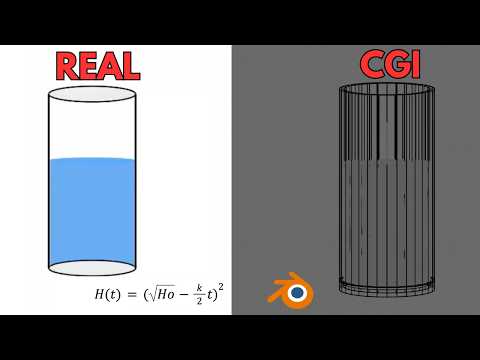
Channel: Angad Bains (5 subscribers)
This is a genuinely interesting cross-disciplinary investigation from a channel with just five subscribers. The creator takes Blender's built-in fluid simulator — the FLIP-based system used in countless VFX shots and game cinematics — and stress-tests it against the actual Navier-Stokes equations that govern real-world fluid behavior.
What makes this worth watching is the framing. Most Blender tutorials show you how to click buttons to get a splash; this one asks the harder question: is the splash physically correct? The video reportedly walks through fluid simulation techniques across games and VFX, then compares CGI output to Newtonian predictions for things like conservation of momentum, viscosity behavior, and surface tension.
For anyone who has ever wondered why CGI water in games looks convincing but CGI water in film looks almost right (uncanny-valley right), this is the kind of analysis that explains it. Real-time fluid solvers cheat aggressively on the pressure projection step and skip vorticity confinement; offline solvers do more of the math but still approximate. Understanding where the approximations live is what separates a technical artist from a button-pusher.
Small-channel caveat: production value will be rough, and depth of derivation is unknown. But the premise — treating a DCC tool as a physics experiment — is exactly the kind of engineering curiosity worth encouraging.
Daily YT Maker
How to Use Procreate Doodles in Cricut Design Space ✨ | Easy Tutorial #diy #craft #cricut #procreate
2026-07-08

Channel: Cat Madeira Design (1820 subscribers)
Note: this batch was thin — the other two candidates were a hashtag-spam garage makeover and a short mist-maker demo, so this tutorial is the clear pick despite being on the short side.
This tutorial bridges two tools that a lot of crafters own but rarely connect: Procreate on the iPad for hand-drawn illustration, and Cricut Design Space for turning those drawings into cut vinyl, iron-on transfers, or stencils. The workflow is the interesting part — Cricut needs clean vector-style paths, but Procreate is a raster app, so getting a doodle to cut well involves specific export settings (transparent PNG, high resolution) and understanding how Design Space traces and thresholds the image on import.
For makers who already have an iPad and a cutting machine sitting on the bench, this kind of pipeline knowledge is what unlocks custom work — logos, decals, layered stickers — without paying for premade SVGs. The channel is small (under 2k subs) but focused specifically on this Procreate/Cricut intersection, which is a legitimately underserved niche.
Daily YT Welding
Precision Machining a Massive Rotary Tiller Gear | Industrial Lathe Restoration"
2026-07-08

Channel: PURE FRAME (392 subscribers)
Nearly every other candidate in today's batch is hashtag-spam Shorts from the same channel, so this is the clear standout — a long-form restoration piece from a tiny 392-subscriber channel documenting the machining of a heavy agricultural gear.
Rotary tiller gearboxes take an enormous beating: they transmit high torque through mud, rocks, and shock loads while running at the PTO's 540 RPM. When the lower drive gear wears or spalls, you can't just order a replacement for older or off-brand implements — someone has to make one. That's where lathe work like this comes in.
Watch for how the operator manages a large, heavy workpiece on the lathe: chucking strategy, indicating true, and the sequence of roughing versus finishing passes. Turning a gear blank requires holding tight tolerances on the bore, hub, and outer diameter before the teeth are even cut, because everything downstream — hobbing or shaping the teeth, heat treatment, and final fit into the housing — depends on those reference surfaces being concentric and square.
For hobbyists or newer machinists, it's a useful look at how industrial-scale lathe work differs from bench-lathe projects: heavier cuts, longer cycle times, and the patience required when a single mistake ruins hours of stock removal.
